


Emery Haley, PhD, Scientific Writing Specialist
Acinetobacter baumannii
Clinical Summary
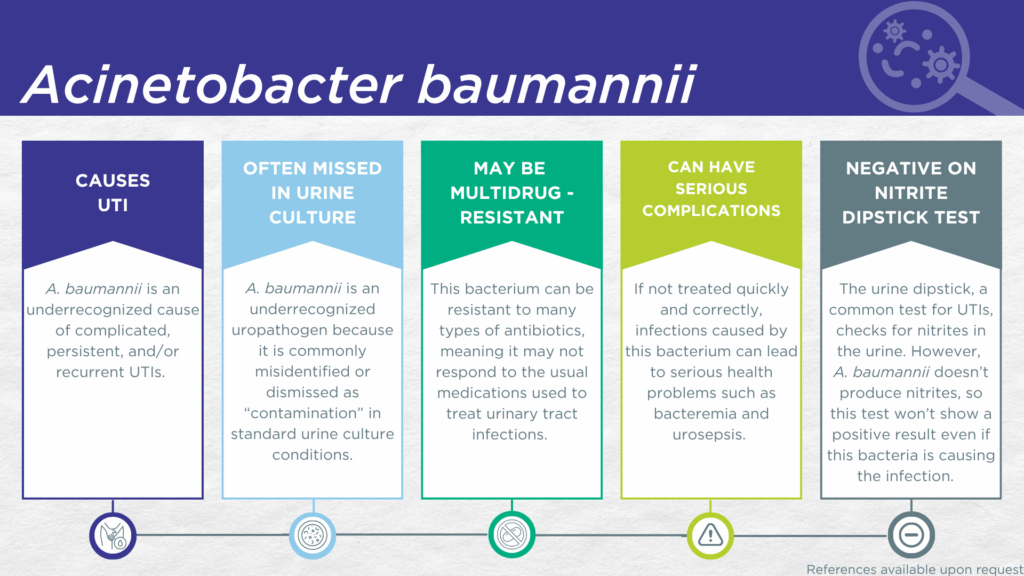
- A. baumannii is a nitrite-negative, biofilm-forming, gram-negative microorganism.
- Some A. baumannii strains exhibit urinary-tract-specific virulence.
- A. baumannii is reported in complicated and catheter-associated UTIs.
- In symptomatic UTI patients, A. baumannii:
- Is not a contaminant (is found in catheter-collected urine specimens).
- Is viable (can grow out on culture).
- Is pathogenic (associated with elevated urine biomarkers of infection).
- Reported severe complications of A. baumannii UTI include bacteremia, urosepsis, and death.
- Multidrug-resistant A. baumannii (including CRAB) is an “ESKAPE” pathogen and a well-studied significant global health threat.
Bacterial Characteristics
Gram-stain
Gram-negative
Morphology
Bacillus
Growth Requirements
Non-fastidious (grows well in standard urine culture conditions)
Obligate aerobe
Nitrate Reduction
No
Urease
Negative
Biofilm Formation
Yes
Pathogenicity
Colonizer or Pathobiont
Clinical Relevance in UTI
A. baumannii is of one of the six so-called “ESKAPE pathogens” identified as critical multi-drug resistant bacteria requiring urgent development of effective therapeutics.[1] Specifically, carbapenem-resistant A. baumannii (CRAB) bacteremia is an increasingly serious global health threat that can arise secondary to A. baumannii UTI.[2] Approximately 17% of clinical A. baumannii isolates are cultured from urine specimens.[3] In the Study for Monitoring Antimicrobial Resistance Trends (SMART) report, which incorporated 276 A. baumannii strains isolated from UTI patients, over 60% of isolates from North America and up to 90% of global isolates were multi-drug resistant.[4] CRAB bacteremia secondary to UTI is a significant risk in hospital settings,[5] particularly among patients with nephrostomy tubes or indwelling catheters.[3,6] However, community-onset [7] and community-acquired [8] A. baumannii complicated UTIs also occur.
Biofilm formation on medical devices, including urinary catheters, is a common clinical feature of A. baumannii. [9] Furthermore, a plasmid conferring increased urinary tract niche-specific virulence has been identified in A. baumannii strains from catheter-associated UTIs.[10] Intriguingly, in mouse models of UTI, A. baumannii formed intracellular reservoirs in the bladder that could be activated by catheterization months after the resolution of the original infection, suggesting one mechanism for some community-based cases. [11] In a study of community-dwelling older adult males and females with clinically suspected complicated UTI, A. baumannii was detected in both midstream voided and in-and-out-catheter collected specimens indicating that it was truly present in the bladder of such patients, not simply a contaminant picked up during voiding.[12]
It is important to note that, although A. baumannii is non-fastidious and grows well under standard urine culture conditions, the organisms lacks nitrate reductase activity, so diagnostic screening strategies involving urinalysis for nitrite positivity will be false-negative.[13,14]
Together, these findings indicate that A. baumannii should be seriously considered as a uropathogen and demonstrate the value of detecting this organism, particularly in individuals with indwelling catheters or other risk factors for complicated UTI.
Treatment
Evidence of Efficacy (Checkmarks): Ampicillin/Sulbactam, Cefepime, Ceftazidime, Ceftriaxone, Ciprofloxacin, Doxycycline, Gentamicin, Levofloxacin, Meropenem, Piperacillin/Tazobactam, and Sulfamethoxazole/Trimethoprim.