


Emery Haley, PhD, Scientific Writing Specialist
Aerococcus urinae
Clinical Summary
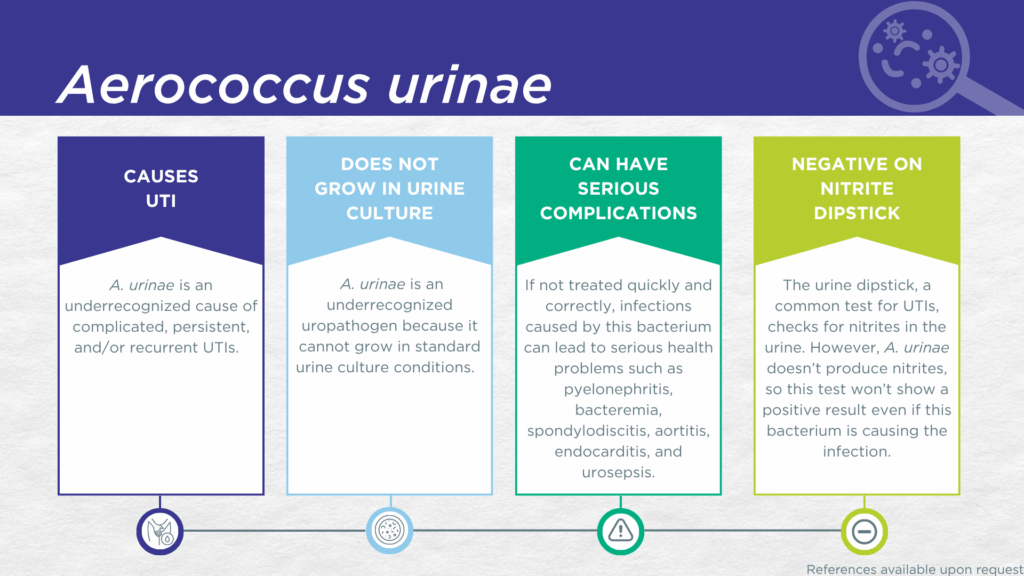
- A. urinae is a nitrite-negative, biofilm-forming, gram-positive microorganism.
- A. urinae is fastidious and cannot grow in standard urine culture conditions.
- A. urinae is associated with complicated UTIs in children, older adults, and individuals with urinary tract abnormalities or multimorbidity.
- A. urinae preferentially infects kidney tissues.
- In symptomatic UTI patients, A. urinae:
- Is not a contaminant (is found in catheter-collected urine specimens).
- Is viable (can grow out in expanded culture conditions).
- Is pathogenic (associated with elevated urine biomarkers of infection).
- Reported severe complications of A. urinae UTI include pyelonephritis, bacteremia, spondylodiscitis, aortitis, endocarditis, and urosepsis.
Bacterial Characteristics
Gram-stain
Gram-positive
Morphology
Coccus
Growth Requirements
Fastidious (prefers blood-agar)
Facultative anaerobe
Nitrate Reduction
No
Urease
Negative
Biofilm Formation
Yes
Pathogenicity
Colonizer or Pathobiont
Clinical Relevance in UTI
A. urinae was first described in 1992 [1] and first sequenced in 2016 [2]. Genome sequencing of additional strain isolates revealed significant genetic diversity [3]and ultimately resulted in the recent splitting of these isolates into four species, including A. urinae and three novel species, A. tenax, A. mictus, and A. loyolae [4,5]. However, there is currently no known association between any of the genetically distinct species and particular clinical phenotypes.[6]
A. urinae is found in asymptomatic individuals as a resident of the human urogenital microbiome.[7] However, it has also been recognized for decades as a ‘rare’ pathogen isolated from human blood and urinary tract infections, predominantly in older adults,[8–15]children,[16–21] and individuals with urinary tract abnormalities or multimorbidity [7,8,15,16,18,22–24]. A. urinae has also been reported to participate in the formation of polymicrobial biofilms on indwelling catheters.[23]
A. urinae UTIs are likely significantly underdiagnosed due to the numerous challenges in the identification of A. urinae. Firstly, A. urinae lacks nitrate reductase activity, so screening strategies involving urinalysis for nitrite positivity will be false-negative.[25,26] Secondly, growing A. urinae in culture requires particular nutritional requirements (blood agar medium), which is not always included in clinical laboratories performing standard culture techniques for UTI diagnosis.[27] Thirdly, even when this organism does grow in culture, as a gram-positive coccus, it is frequently confused with Staphylococcus, Streptococcus, or Enterococcus species and may be dismissed as an irrelevant gram-positive “contaminant” organism from the urogenital microbiome.[15,27,28] Instead, A. urinae UTI is most often diagnosed by advanced proteomic techniques, such as Matrix-assisted laser desorption ionization-time of flight mass spectrometry (MALDI-TOF MS), or advanced molecular techniques, including polymerase chain reaction (PCR) and sequencing.[9,22,28–30]
A study using expanded quantitative urine culture (EQUC), a technique growing a larger urine volume with additional nutritional media, different atmospheric conditions, and longer incubations, found that the organism was viable. [31] In a study of older adult males and females with clinically suspected complicated UTI, A. urinae was detected in both midstream voided and in-and-out-catheter collected specimens indicating that it was truly present in the bladder, not simply a contaminant picked up during voiding.[30] Furthermore, elevated markers of immune system activation in the urinary tract have been measured from the same clinical urine specimens in which A. schaalii was detected, indicating that the presence of A. urinae was associated with an immune response to urinary tract infection.[32–34]
Critically, A. urinae demonstrates specific tropism for the kidney in mouse models of UTI.[6] Therefore, ascending infection with progression from cystitis to pyelonephritis is a significant risk. A. urinae in the kidney can readily cross into the bloodstream, resulting in bacteremia [22] that may progress to urosepsis [29]. A. urinae that reaches the bloodstream is also known to cause serious invasive infections including reports of spondylodiscitis,[35] aortitis,[36] endocarditis with aortic wall ulcer,[37] endocarditis of the aortic valve,[38] endocarditis with mycotic aneurysms,[39] and endocarditis requiring mitral valve replacement [40]. Indeed, strain matching of A. urinae isolated from the urine and from invasive disseminated infection sites confirms that the urinary tract is frequently the point of origin for such infection.[22,29,35]
Together, these findings demonstrate the value of detecting this organism and indicate that A. urinae should be seriously considered as a uropathogen when detected in any individual with UTI symptoms.
Treatment
Evidence of Efficacy (Checkmarks): Amoxicillin/Clavulanate, Ampicillin, Ampicillin/Sulbactam, Cefazolin, Ceftriaxone, Doxycycline, Fosfomycin, Gentamicin, Linezolid, Meropenem, Nitrofurantoin, Piperacillin/Tazobactam, and Vancomycin.