

Emery Haley, PhD, Scientific Writing Specialist
Candida auris
Clinical Summary
- C. auris is an emerging, multidrug resistant, fungal pathogen with a high mortality rate for invasive infections.
- C. auris may cause symptomatic UTI or may asymptomatically colonize the urinary tract.
- Detection of C. auris in a urine specimen is nationally notifiable to the CDC and should prompt the implementation of infection control measures.
- High-risk patients with detection of C. auris in a urine specimen should be monitored/tested for invasive infection.
Yeast Characteristics
Growth Requirements
A Yeast (slow growth, prefers yeast extract peptone dextrose medium and acidic pH)
Biofilm Formation
Yes
Nitrate Reduction
No
Pathogenicity
Colonizer or Pathobiont
Clinical Relevance in UTI
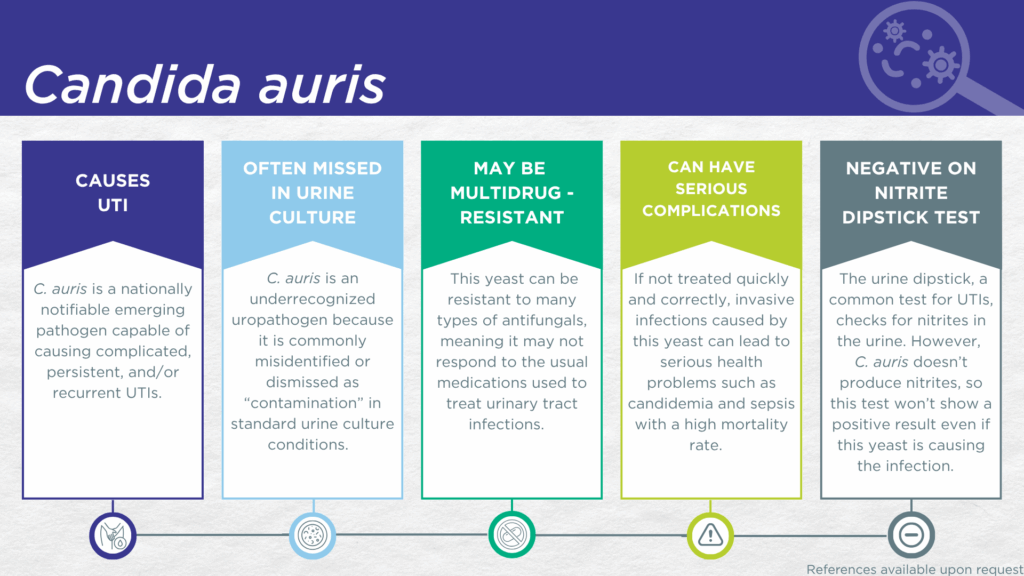
C. auris is an emerging fungus that presents a serious global health threat. C. auris is frequently resistant to commonly used antifungal medications, resulting in high persistence and recurrence rates, as well as high mortality rates for invasive infections.[1,2] Due to its multi-drug-resistant nature, the detection of C. auris is a nationally notifiable disease.[3]
Unlike common bacterial uropathogens, yeasts do not display nitrate reductase activity, so screening strategies involving urinalysis for nitrite positivity will be false-negative.[4,5] C. auris is frequently unidentified or misidentified by traditional culture-based techniques, and is therefore, primarily detected by PCR.[6]
Infection control measures are imperative in managing C. auris UTIs, especially among long-term care and acute inpatient care facilities, as there is a significant risk for transmission of a multidrug resistant C. auris infection.[7]
Treatment
Currently, the United States Centers for Disease Control (CDC) does not recommend treating C. auris when detected in non-invasive sites, including urine.[1] Visit https://www.cdc.gov/candida-auris/index.html for further guidance on C. auris. However, in patients with diabetes, recent surgery, indwelling medical devices, or similar risk factors, detection of C. auris in a urine specimen warrants close monitoring for signs of invasive C. auris infection.
The first-line treatment for invasive C. auris infections is typically an intravenous (IV) echinocandin antifungal.[1,8] C. auris is known to be intrinsically resistant to azole class antifungals, including fluconazole.[1,8] A significant proportion of C. auris isolates are also resistant to Amphotericin B, and resistance to Flucytosine is uncommon, but may develop during monotherapy treatment.[1,8] Combination therapies or investigational treatments may be necessary due to the multidrug-resistant nature of C. auris.[1,8]