


Emery Haley, PhD, Scientific Writing Specialist
Candida glabrata
Clinical Summary
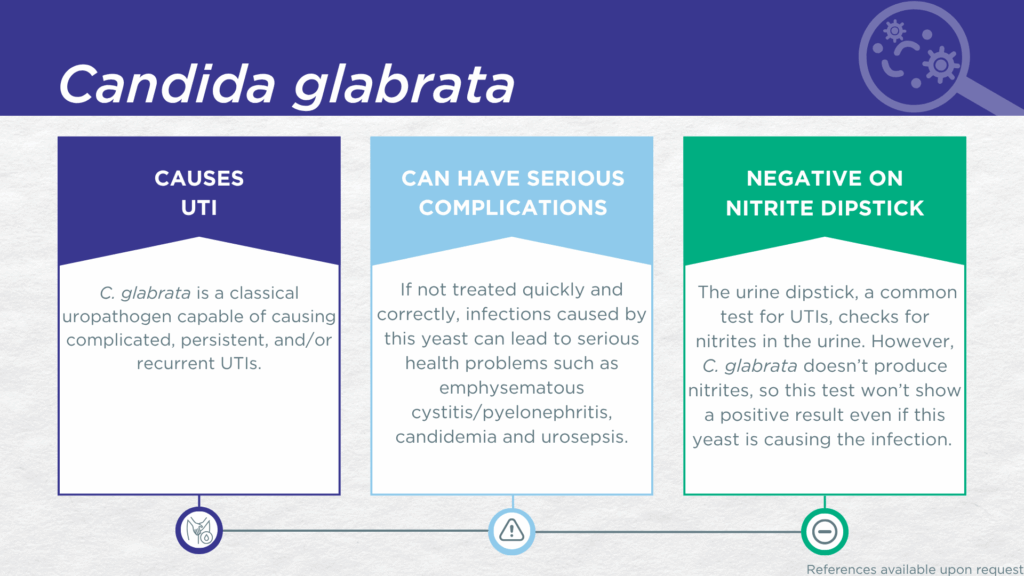
- C. glabrata is recognized as a classical, biofilm-forming, yeast uropathogen.
- C. glabrata is associated with complicated UTI.
- In symptomatic UTI patients, C. glabrata:
- Is not a contaminant (is found in catheter-collected urine specimens).
- Is viable (can grow out on culture).
-
Is pathogenic (associated with elevated urine biomarkers of infection).
-
Reported severe complications of C. glabrata UTI include emphysematous cystitis/pyelonephritis, bacteremia and urosepsis.
Yeast Characteristics
Growth Requirements
A Yeast (slow growth, prefers yeast extract peptone dextrose medium and acidic pH)
Biofilm Formation
Yes
Nitrate Reduction
No
Pathogenicity
Colonizer or Pathobiont
Clinical Relevance in UTI
UTIs can be caused by yeasts and Candida yeast species are classically recognized as uropathogens.[1–4]
Unlike common bacterial uropathogens, yeasts do not display nitrate reductase activity, so screening strategies involving urinalysis for nitrite positivity will be false-negative.[5,6]
C. glabrata is primarily seen in complicated UTIs among high-risk patient populations such as young children, individuals with abnormalities of the urinary tract and/or indwelling catheters, adults with immunocompromising comorbidities including diabetes mellitus, and hospitalized patients admitted to intensive care units.[7–9]
In a study of older adult males and females with clinically suspected complicated UTI, C. glabrata was detected in both midstream voided and in-and-out-catheter collected specimens indicating that it was truly present in the bladder, not simply a contaminant picked up during voiding.[10] Furthermore, elevated markers of immune system activation in the urinary tract have been measured from the same clinical urine specimens in which C. glabrata was detected, indicating that the presence of C. glabrata was associated with an immune response to urinary tract infection.[11–13]
Severe complications of C. glabrata UTI, including emphysematous cystitis/pyelonephritis, candidemia and urosepsis, have been reported.[14–19]
Together, these findings indicate that C. glabrata should be seriously considered as a uropathogen and demonstrate the value of detecting this organism, particularly in individuals with immune compromise, urinary tract abnormalities, or other risk factors for complicated UTI.
Treatment
Flucytosine (PO) is the clinically recommended antifungal agent for the treatment of C. glabrata UTIs.[20] Note that C. glabrata is frequently resistant to Fluconazole, and other antifungal agents do not reach therapeutic concentrations in the urine.