

Emery Haley, PhD, Scientific Writing Specialist
Corynebacterium riegelii
Clinical Summary
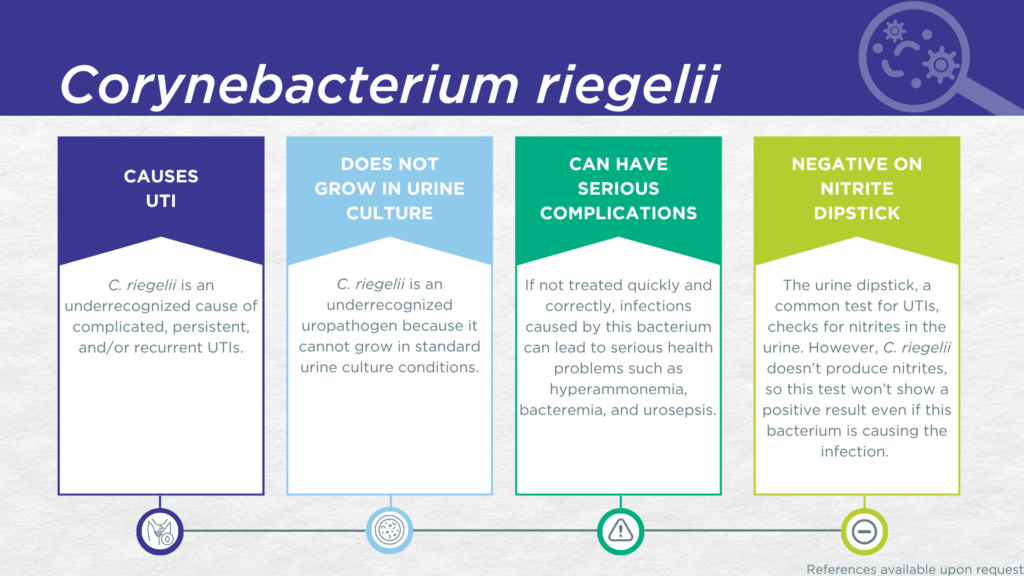
- C. riegelii is a nitrite-negative, urease-positive, gram-positive, microorganism.
- C. riegelii is fastidious and cannot grow in standard urine culture conditions.
- C. riegelii is associated with complicated UTIs.
- In symptomatic UTI patients, C. riegelii:
- Is not a contaminant (is found in catheter-collected urine specimens).
- Is viable (can grow out in expanded culture conditions).
- Is pathogenic (associated with elevated urine biomarkers of infection).
- Reported severe complications of C. riegelii UTI include hyperammonemia, bacteremia, urosepsis, and death.
Bacterial Characteristics
Gram-stain
Gram-positive
Morphology
Bacillus
Growth Requirements
Fastidious (slow growing, prefers blood-agar and 5% CO2)
Microaerophile
Nitrate Reduction
No
Urease
Positive
Biofilm Formation
Unclear
Pathogenicity
Colonizer or Pathobiont
Clinical Relevance in UTI
C. riegelii is a urease-positive microorganism [1]first identified in 1998 by isolation in monoculture with densities > 105 CFU/mL from four female UTI patients with pyuria.[2]
C. riegelii UTIs are likely significantly underdiagnosed due to the numerous challenges in diagnostics. Firstly, C. riegelii lacks nitrate reductase activity, so screening strategies involving urinalysis for nitrite positivity will be false-negative.[1,3] Secondly, in culture, C. riegelii grows preferentially in an anaerobic atmosphere with at least 5% CO2, with particular nutrients (blood agar medium), and needs extended incubation times of at least 48 hours.[2] These conditions are not typically used in clinical laboratories performing standard culture techniques for UTI diagnosis. Thirdly, even when this organism does grow in culture, it is often overgrown by other faster-growing species or dismissed as an irrelevant gram-positive commensal organism of the urogenital microbiome and labeled as a “contaminant”.[4] Instead, C. riegelii UTI is most often diagnosed by advanced proteomic techniques, such as Matrix-assisted laser desorption ionization-time of flight mass spectrometry (MALDI-TOF MS), or advanced molecular techniques, including polymerase chain reaction (PCR) and sequencing.[4]
A study using expanded quantitative urine culture (EQUC), a technique growing a larger urine volume with additional nutritional media, different atmospheric conditions, and longer incubations, found that the organism was viable.[5] In a study of older adult males and females with clinically suspected complicated UTI, C. riegelii was detected in both midstream voided and in-and-out-catheter collected specimens indicating that it was truly present in the bladder, not simply a contaminant picked up during voiding.[6] Furthermore, elevated markers of immune system activation in the urinary tract have been measured from the same clinical urine specimens in which C. riegelii was detected, indicating that the presence of C. riegelii was associated with an immune response to urinary tract infection.[7–9]
Severe complications of C. riegelii UTI, including hyperammonemia [10] and urosepsis,[11–13] have been reported, with one confirmed death from C. riegelii urosepsis [13].
Together, these findings indicate that C. riegelii should be seriously considered as a uropathogen and demonstrate the value of detecting this organism, particularly in individuals with immune-compromising comorbidities or other risk factors for complicated UTI.
Treatment
Evidence of Efficacy (Checkmarks): Ampicillin, Ampicillin/Sulbactam, Cefepime, Ceftriaxone, Ciprofloxacin, Doxycycline, Gentamicin, Linezolid, Sulfamethoxazole/Trimethoprim, and Vancomycin.