

Emery Haley, PhD, Scientific Writing Specialist
Cefaclor
Find the Latest FDA-Approved Labelling Information Here: Drugs@FDA Online Database
Administrative Routes
Oral (PO)
Other Names
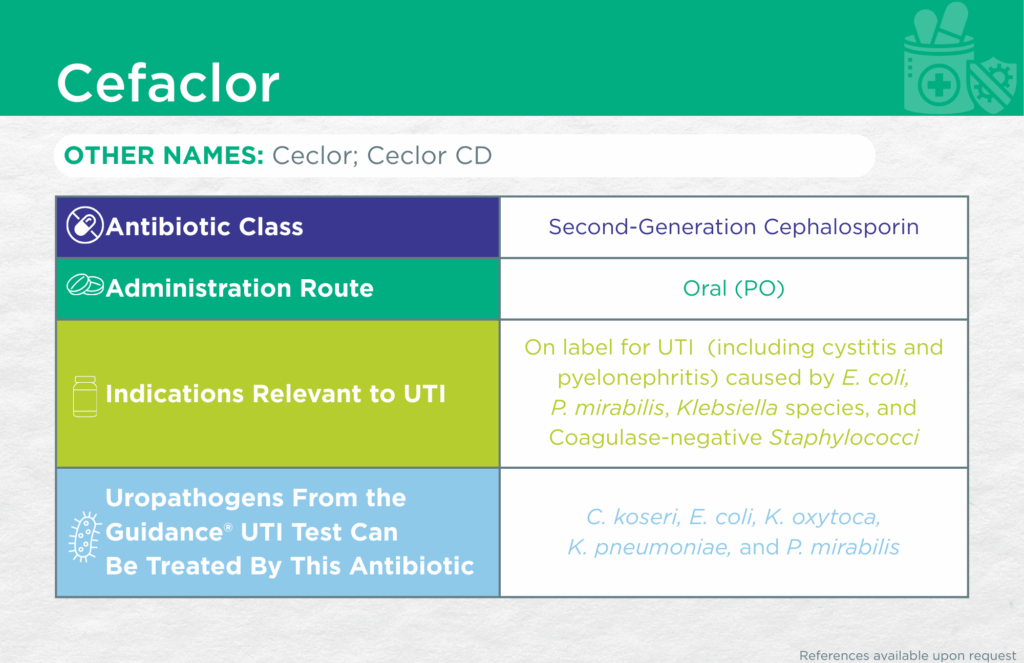
Ceclor; Ceclor CD
Bacteriostatic or Bactericidal
Bactericidal [1]
Antibiotic Class
Second-Generation Cephalosporin
Mechanisms of Action
Cefaclor, a beta-lactam antibiotic, binds to penicillin-binding proteins (PBPs) on bacterial cell walls. PBPs are essential for the formation of peptidoglycan, which gives the bacterial wall strength and integrity. Binding of cefaclor to PBPs leads to failure of peptidoglycan cell wall synthesis, causing bacterial cell death.
WHO AWaRe Classification
Watch [2]
Empiric Use Recommendations
Yes (alternative for complicated UTI without suspected sepsis) [Infectious Diseases Society of America (IDSA)] [3]
Indication(s) Relevant to UTI
On label for UTI (including cystitis and pyelonephritis) caused by Escherichia coli, Proteus mirabilis, Klebsiella species, and Coagulase-negative Staphylococci.
Checkmarks
CLSI and/or FDA documents support the efficacy of this antibiotic against the following organisms from the Guidance® UTI test: Citrobacter koseri, Escherichia coli, Klebsiella oxytoca, Klebsiella pneumoniae, and Proteus mirabilis.