

UTI Knowledge Center
Antibiotic Spotlight

Cefazolin

Emery Haley, PhD, Scientific Writing Specialist

Cefazolin

Find the Latest FDA-Approved Labelling Information Here: Drugs@FDA Online Database

Administrative Routes

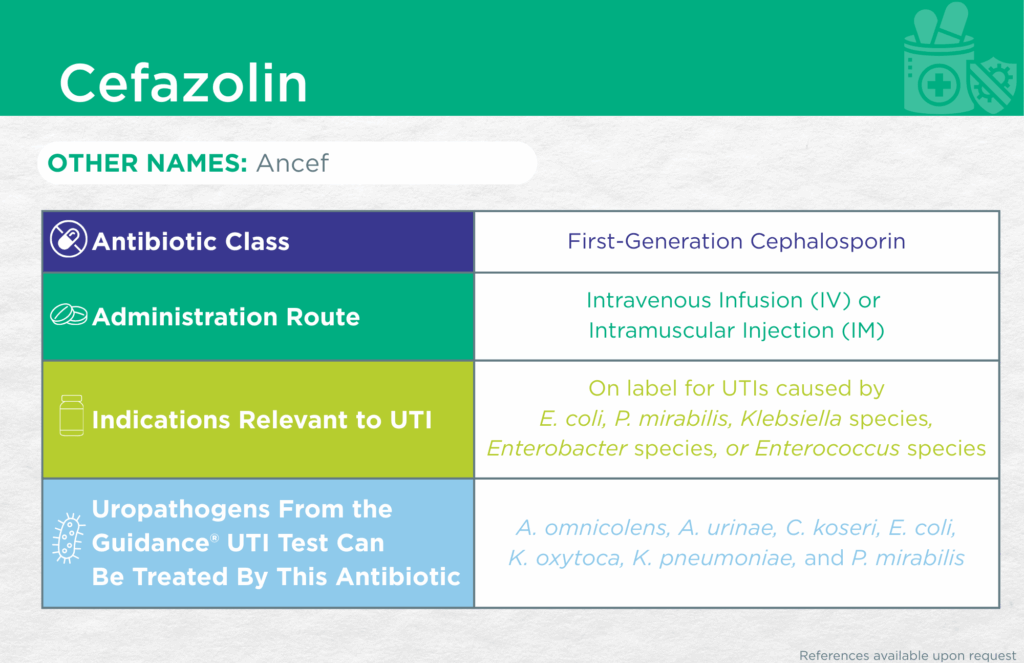
Parenteral [intravenous infusion (IV) or intramuscular injection (IM)]

Other Names

Ancef

Bacteriostatic or Bactericidal

Bactericidal [1]

Antibiotic Class

First-Generation Cephalosporin

Mechanisms of Action

Cefazolin, a beta-lactam antibiotic, binds to penicillin-binding proteins (PBPs) on bacterial cell walls. PBPs are essential for the formation of peptidoglycan, which gives the bacterial wall strength and integrity. Binding of cefazolin to PBPs leads to failure of peptidoglycan cell wall synthesis, causing bacterial cell death.

WHO AWaRe Classification

Access [2]

Empiric Use Recommendations

No published guidance

Indication(s) Relevant to UTI

On label for UTIs caused by Escherichia coli, Proteus mirabilis, Klebsiella species, Enterobacter species, and Enterococcus species.

Checkmarks

CLSI and/or FDA documents support the efficacy of this antibiotic against the following organisms from the Guidance® UTI test: Aerococcus urinae, Citrobacter koseri, Escherichia coli, Klebsiella oxytoca, Klebsiella pneumoniae, and Proteus mirabilis  

Published primary literature supports the efficacy of this antibiotic against the following organism from the Guidance® UTI test: Alloscardovia omnicolens [3]

About the Author

Dr. Emery Haley is a scientific writing specialist with over ten years of experience in translational cell and molecular biology. As both a former laboratory scientist and an experienced science communicator, Dr. Haley is passionate about making complex research clear, approachable, and relevant. Their work has been published in over 10 papers and focuses on bridging the gap between the lab and real-world patient care to help drive better health outcomes.

Ready to see what better diagnostics can do for your practice?

Talk to a Pathnostics representative about Guidance® UTI and our other tests.

References
  1. Ishak, A.; Mazonakis, N.; Spernovasilis, N.; Akinosoglou, K.; Tsioutis, C. Bactericidal versus Bacteriostatic Antibacterials: Clinical Significance, Differences and Synergistic Potential in Clinical Practice. J. Antimicrob. Chemother. 2024, 80, 1–17, doi:10.1093/jac/dkae380
  2. AWaRe Classification of Antibiotics for Evaluation and Monitoring of Use, 2023 Available online: https://www.who.int/publications/i/item/WHO-MHP-HPS-EML-2023.04 (accessed on 6 February 2025).
  3. Isnard, C.; Lienhard, R.; Reissier, S.; Rodriguez, S.; Krähenbühl, J.; Liassine, N.; Guérin, F.; Cattoir, V. In Vitro Antimicrobial Susceptibility of Alloscardovia Omnicolens and Molecular Mechanisms of Acquired Resistance. Diagnostic Microbiology and Infectious Disease 2016, 84, 227–229, doi:10.1016/j.diagmicrobio.2015.08.009.