


Emery Haley, PhD, Scientific Writing Specialist
Coagulase-negative Staphylococci Group
Clinical Summary
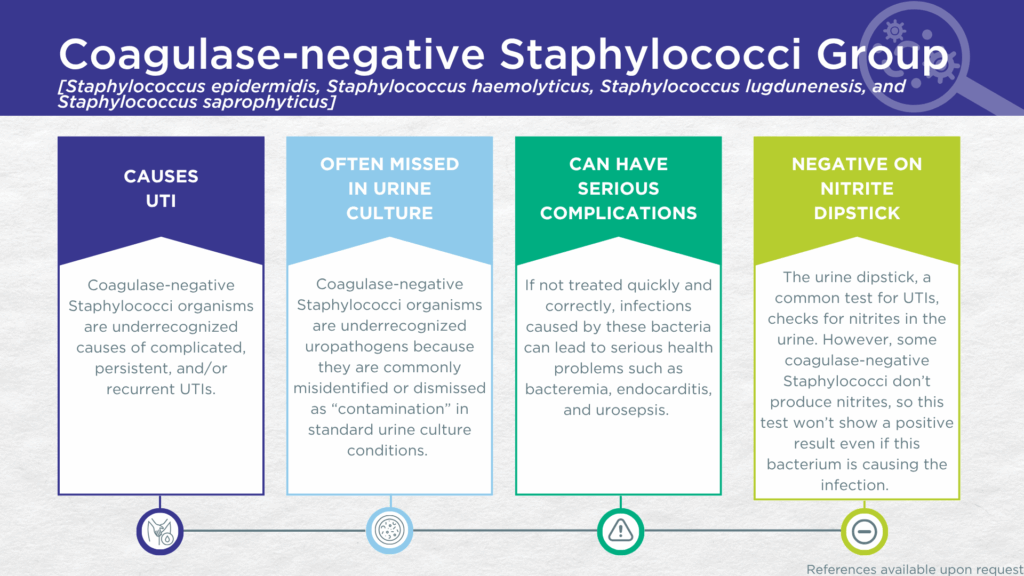
- CoNS are biofilm-forming, gram-positive microorganisms that may be urease-positive.
- CoNS are occasionally nitrite-negative on urinalysis dipsticks.
- CoNS are commonly dismissed as contaminants in standard urine culture conditions.
- CoNS are associated with recurrent UTIs in post-pubertal women and with complicated and persistent UTIs in men and children.
- In symptomatic UTI patients, CoNS:
- Are not a contaminant (is found in catheter-collected urine specimens).
- Are viable (can grow out on culture).
- Are pathogenic (associated with elevated urine biomarkers of infection).
- Reported severe complications of CoNS UTI include bacteremia endocarditis, and urosepsis.
Bacterial Characteristics
Gram-stain
Gram-positive (all)
Morphology
Coccus (all)
Growth Requirements
Non-fastidious (all grow well in standard urine culture conditions)
Facultative anaerobe
Nitrate Reduction
Yes (except S. saprophyticus is variable for this phenotype)
Urease
Positive (S. epidermidis and S. saprophyticus)
Negative (S. haemolyticus and S. lugdunenesis)
Biofilm Formation
Yes (all)
Pathogenicity
Colonizer or Pathobiont
Clinical Relevance in UTI
Coagulase-negative Staphylococci (CoNS) is a group of Staphylococcus species that are grouped according to the shared characteristic they are named for: lack of the virulence factor coagulase.[1] They are traditionally described as gram-positive commensals of the human skin microbiome.[2] In the Guidance® UTI assay, this group term specifically encompasses four species, S. epidermidis, S. haemolyticus, S. lugdunenesis, and S. saprophyticus.
S. epidermidisS. epidermidis is a urease-positive microorganism [3] associated with biofilm formation in catheter-associated UTI [4] and with calcifications in chronic bacterial prostatitis [5]. S. epidermidis is also associated with UTI and pyelonephritis in young children, adolescent males, and children with urinary tract abnormalities [6–8]. S. epidermidis was also reported in an adult female with recurrent UTI [9] and in two adult males with nephrolithiasis, pyelonephritis, and bacteremia secondary to UTI.[10] Additionally, in a sequencing-based study, S. epidermidis was detected only in interstitial cystitis/bladder pain syndrome (IC/BPS) patient urine specimens but not in asymptomatic controls, suggesting that these patients’ lower urinary tract symptoms were due to unrecognized/untreated S. epidermidis UTIs.[11] S. epidermidis UTI isolates are frequently multi-drug resistant.[12]
S. haemolyticus
S. haemolyticus is associated with UTI in pregnant women [13] and with UTI and pyelonephritis in young children, adolescent males, and children with urinary tract abnormalities [6] S. haemolyticus was also reported in an adult female with recurrent UTI, [14] in an adult male with persistent UTI,[15] and in an adult male with urosepsis, urinary blockage, and prostatic abscess secondary to UTI.[16] S. haemolyticus UTI isolates are frequently multi-drug resistant.[12,17,18]
S. lugdunenesis
S. lugdunenesis is associated with UTI, and specifically with pyelonephritis, in adult and adolescent males, as well as children of any sex with underlying urinary tract abnormalities.[6,19] S. lugdunenesis was also reported in an immune-compromised adult female [20] and in five adult females with lower urinary tract symptoms.[14] Furthermore, S. lugdunenesis was identified by expanded quantitative urine culture (EQUC) in catheter-obtained urine samples from UTI patients but not asymptomatic controls.[21,22] S. lugdunenesis UTI, especially pyelonephritis, can lead to bacteremia [23] and S. lugdunenesis bacteremia is associated with severe complications, including aggressive endocarditis [24,25] and pericarditis [26].
S. saprophyticus
S. saprophyticus is a urease-positive,[3] biofilm-forming [27,28] microorganism. S. saprophyticus is considered a common cause of acute uncomplicated cystitis [6] and recurrent UTI [29] in post-pubertal adolescent and young-adult females. S. saprophyticus was also reported to cause pyelonephritis, bacteremia, and urosepsis in a pregnant 17-year-old female [30] and an immune-compromised 64-year-old female [31]. S. saprophyticus UTI isolates are frequently multi-drug resistant.[27,28]
The Coagulase-negative Staphylococci Group
CoNS UTIs are likely significantly underdiagnosed for a couple of reasons. Firstly, some strains of the S. saprophyticus species lack nitrate reductase activity, so screening strategies involving urinalysis for nitrite positivity may be false-negative.[3,32] Secondly, although these organisms grow readily in standard urine culture conditions, they are commonly dismissed as irrelevant gram-positive commensal organisms of the urogenital microbiome and labeled as a “contaminant”.[33]
However, in a study of older adult males and females with clinically suspected complicated UTI, CoNS was detected in both midstream voided and in-and-out-catheter collected specimens indicating that it was truly present in the bladder, not simply a contaminant picked up during voiding.[34] Furthermore, elevated markers of immune system activation in the urinary tract have been measured from the same clinical urine specimens in which CoNS was detected, indicating that the presence of CoNS was associated with an immune response to urinary tract infection.[35–37]
Despite their reputation as contaminants, CoNS (S. epidermidis, S. haemolyticus, S. lugdunenesis, and S. saprophyticus) are all associated with complicated, persistent, and/or recurrent UTIs, as well as with severe complications such as bacteremia and endocarditis. Together, these findings indicate that CoNS should be seriously considered as a uropathogen and demonstrate the value of detecting these organisms, particularly in individuals with immune compromise or other risk factors for complicated, persistent, or recurrent UTI.
Treatment
Evidence of Efficacy (Checkmarks): Doxycycline, Linezolid, Nitrofurantoin, Sulfamethoxazole/Trimethoprim, Trimethoprim, and Vancomycin.