


Emery Haley, PhD, Scientific Writing Specialist
Gardnerella vaginalis
Clinical Summary
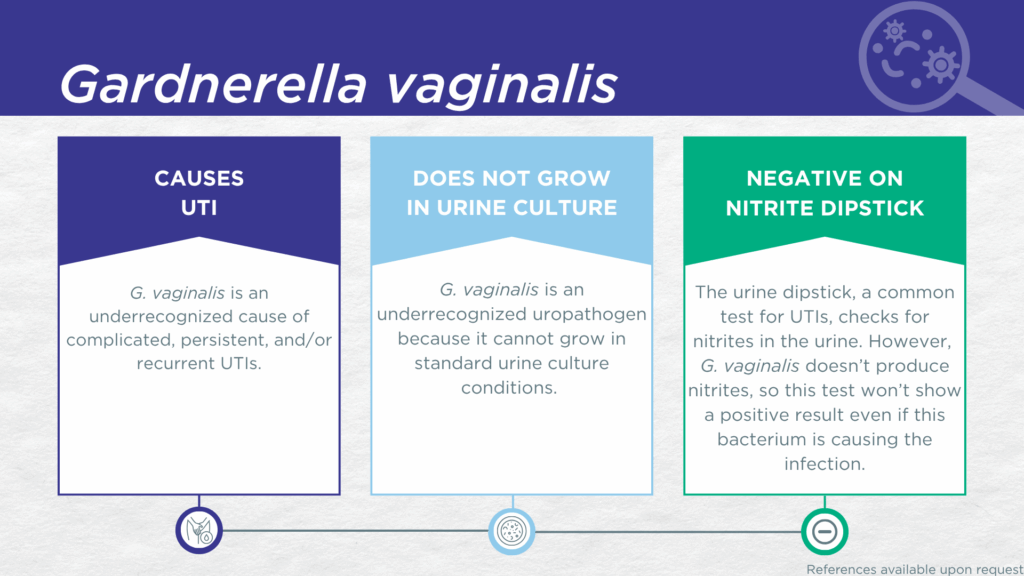
- G. vaginalis is a nitrite-negative, biofilm-forming, gram-variable microorganism.
- G. vaginalis is fastidious and cannot grow in standard urine culture conditions.
- G. vaginalis is associated with complicated and recurrent UTIs in both males and females.
- In symptomatic UTI patients, G. vaginalis:
- Is not a contaminant (is found in catheter-collected urine specimens).
- Is viable (can grow out in expanded culture conditions).
- Is pathogenic (associated with elevated urine biomarkers of infection).
Bacterial Characteristics
Gram-stain
Gram-variable
Although G. vaginalis lacks an outer membrane, consistent with gram-positive microorganisms, it also has an unusually thin peptidoglycan-containing cell wall. That causes this organism to appear gram-negative, depending on the staining method.
Morphology
Coccobacillus (intermediate between round and rod-shaped)
Growth Requirements
Fastidious
Obligate anaerobe/microaerophile
Nitrate Reduction
No
Urease
Negative
Biofilm Formation
Yes
Pathogenicity
Colonizer or Pathobiont
Clinical Relevance in UTI
Clinically, G. vaginalis is best recognized for its role in bacterial vaginosis (BV).[1] This fastidious organism is typically considered a colonizer of the vaginal microbiome and has previously been dismissed as a contaminant when detected in midstream voided urine specimens.[2,3] However, studies of the vaginal and bladder microbiomes have found that these two microbiomes have a high similarity within one individual, suggesting important interconnectivity of these microbial communities.[4–6]
Despite associations with the vaginal microbiome and BV, the clinical relevance of G. vaginalis is not limited to adult females. G. vaginalis has been detected in voided urine specimens of both pediatric female patients [7,8] and adult patients (both male and female) [9] with clinically suspected UTI. G. vaginalis has been recovered from the urinary tract of men, potentially via exposure from female sexual partners.[10–12] Though uncommon, G. vaginalis prostatitis [13] and bacteremia secondary to urinary tract infection (UTI) [14] have also been reported in men.
G. vaginalis UTI is underdiagnosed because the organism lacks nitrate reductase activity, so screening strategies involving urinalysis for nitrite positivity will be false-negative.[15,16] Additionally, growing G. vaginalis in culture requires an anaerobic atmosphere which is not typically used in clinical laboratories performing standard culture techniques for UTI diagnosis.[17] Instead, G. vaginalis UTI is most often diagnosed by advanced molecular techniques, including polymerase chain reaction (PCR) and sequencing.[8,18,19]
G. vaginalis has recently been specifically linked to both urobiome dysbiosis and recurrent UTIs (rUTIs) [1,18] and pre-clinical studies have demonstrated that transurethral exposure of bladder cells to G. vaginalis triggers immune activation, urothelial exfoliation, and rUTI due to the emergence of uropathogenic E. coli from bladder reservoirs. A study using expanded quantitative urine culture (EQUC), a technique growing a larger urine volume with additional nutritional media, different atmospheric conditions, and longer incubations, found that the organism was viable.[20] In a study of older adult males and females with clinically suspected complicated UTI, G. vaginalis was detected in both midstream voided and in-and-out-catheter collected specimens, indicating that it was truly present in the bladder, not simply a contaminant picked up during voiding.[19] Furthermore, elevated markers of immune system activation in the urinary tract have been measured from the same clinical urine specimens in which G. vaginalis was detected, indicating that the presence of G. vaginalis was associated with an immune response to urinary tract infection.[21–23]
Together, these findings demonstrate the value of detecting this organism and indicate that G. vaginalis should be seriously considered as a uropathogen when detected in any individual with UTI symptoms.
Treatment
Evidence of Efficacy (Checkmarks) [14,24–26]: Ampicillin
For G. vaginalis UTI, oral ampicillin and oral metronidazole are the recommended treatment options.[26]Standard treatment regimens for vaginal G. vaginalis in BV involve oral metronidazole, intravaginal topical metronidazole gel, or intravaginal topical clindamycin cream.[25] Studies and case reports have also indicated amoxicillin/clavulanate, sulfamethoxazole/trimethoprim, ciprofloxacin, and vancomycin as clinically effective against systemic G. vaginalis infection.[14,24]