

Emery Haley, PhD, Scientific Writing Specialist
Providencia stuartii
Clinical Summary
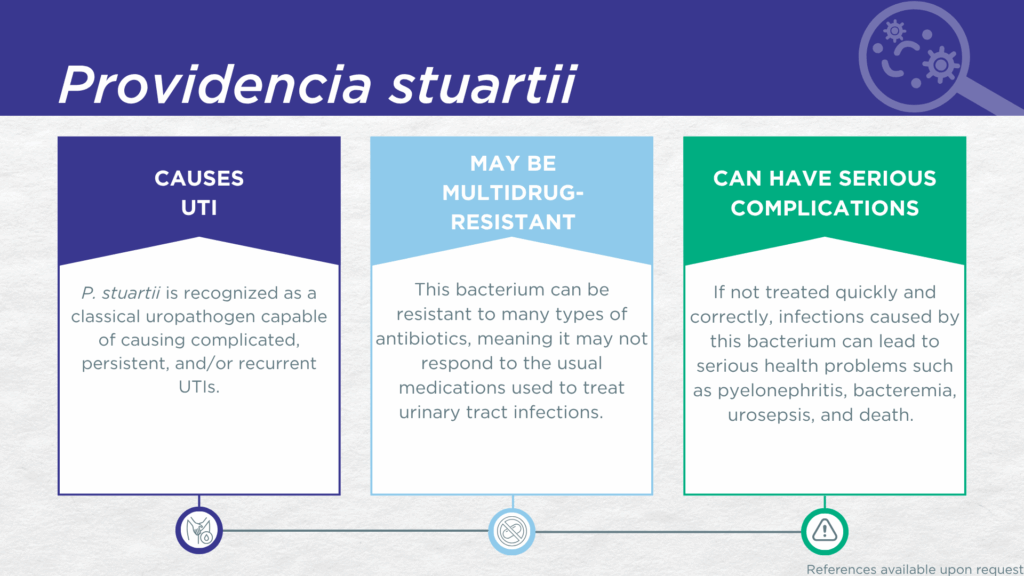
- P. stuartii is recognized as a classical, urease-variable, gram-negative, biofilm-forming, uropathogen.
- P. stuartii is primarily associated with complicated and persistent catheter-associated or hospital-acquired UTIs, especially among older adults with multi-morbidity.
- In symptomatic UTI patients, P. stuartii:
- Is not a contaminant (is found in catheter-collected urine specimens).
- Is viable (can grow out on culture).
- Reported severe complications of P. stuartii UTI include xanthogranulomatous pyelonephritis, bacteremia, urosepsis, and death.
- Multidrug-resistant P. stuartii is a significant global health threat.
Bacterial Characteristics
Gram-stain
Gram-negative
Morphology
Bacillus
Growth Requirements
Non-fastidious (grows well in standard urine culture conditions)
Facultative anaerobe
Nitrate Reduction
Yes
Urease
Variable
Biofilm Formation
Yes
Pathogenicity
Colonizer or Pathobiont
Clinical Relevance in UTI
P. stuartii is a gram-negative, urease-variable,[1] bacterium with potent biofilm-forming capabilities. It is a classically recognized uropathogen, particularly well-known for its association with catheter-associated UTIs (CAUTIs) and hospital-acquired UTIs (HAUTIs) particularly among older adults and individuals with multiple comorbidities.[2,3]
P. stuartii is infamous for forming multidrug-resistant, polymicrobial, biofilms on indwelling urinary catheters.[4,5] In preclinical studies P. stuartii demonstrated synergism with P. mirabilis, including increased urease activity, urolithiasis, cell/tissue damage, and bacteremia.[4,6,7] In contrast, P. stuartii has been demonstrated to exhibit antagonism with Enterococcus species, E. coli, and M. morganii.[6]
The predilection of P. stuartii for forming multidrug-resistant biofilms results in difficult-to-treat complicated and persistent UTIs. In a study of older adult males and females with clinically suspected complicated UTI, P. stuartii was detected in both midstream voided and in-and-out-catheter collected specimens indicating that it was truly present in the bladder, not simply a contaminant picked up during voiding.[8]
Although not considered one of the six highest priority “ESKAPE” pathogens, the World Health Organization (WHO) has included third-generation-cephalosporin-resistant and carbapenem-resistant Enterobacterales, including P. stuartii, in the “critical” group of the 2024 Bacterial Priority Pathogens List (BPPL).[9] Reported severe complications of P. stuartii UTI include xanthogranulomatous pyelonephritis, bacteremia, urosepsis, and death.[10–12]
Together, these findings indicate that P. stuartii should be seriously considered as a uropathogen and demonstrate the value of detecting this organism, particularly in individuals with indwelling catheters or other risk factors for complicated UTI.
Treatment
Evidence of Efficacy (Checkmarks): Ampicillin/Sulbactam, Cefepime, Ciprofloxacin, Levofloxacin, Meropenem, Piperacillin/Tazobactam, Sulfamethoxazole/Trimethoprim, and Trimethoprim.