

Emery Haley, PhD, Scientific Writing Specialist
Staphylococcus aureus
Clinical Summary
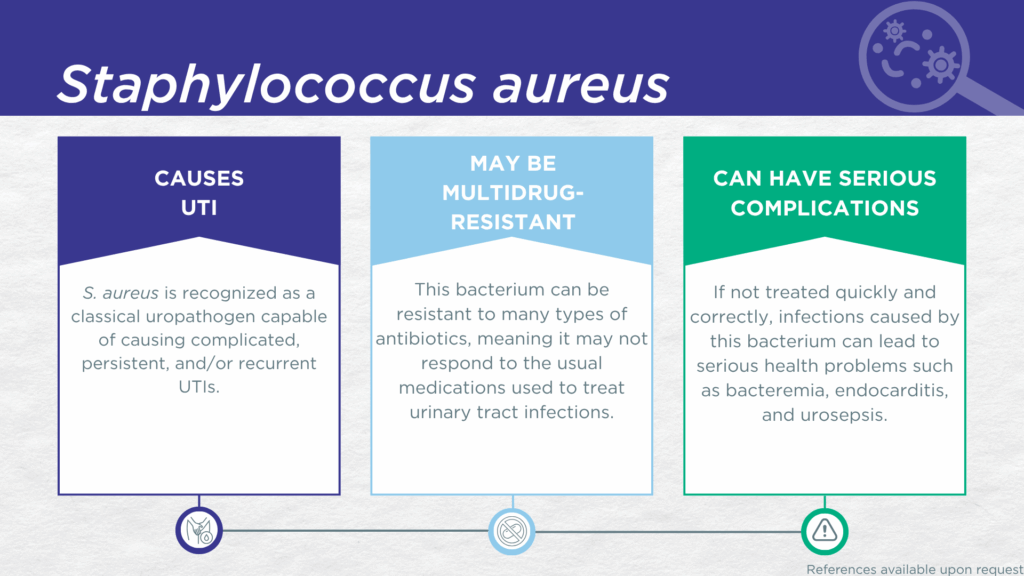
- S. aureus is recognized as a classical gram-positive, urease-positive, biofilm-forming uropathogen.
- S. aureus is associated with complicated, persistent, and recurrent UTI (the same population for which the Guidance® UTI assay is indicated).
- In symptomatic UTI patients, S. aureus:
- Is not a contaminant (is found in catheter-collected urine specimens).
- Is viable (can grow out on culture).
- Is pathogenic (associated with elevated urine biomarkers of infection).
- Reported severe complications of S. aureus UTI include bacteremia, endocarditis, and urosepsis.
- Multidrug-resistant aureus (including MRSA) is an “ESKAPE” pathogen and a well-studied significant global health threat.
- Note: Pathnostics offers a MRSA-phenotype add-on reflex assay.
Bacterial Characteristics
Gram-stain
Gram-positive
Morphology
Coccus
Growth Requirements
Non-fastidious (grows well in standard urine culture conditions)
Facultative anaerobe
Nitrate Reduction
Yes
Urease
Positive
Biofilm Formation
Yes
Pathogenicity
Colonizer or Pathobiont
Clinical Relevance in UTI
S. aureus is a urease-positive microorganism[1] typically considered to be a classical uropathogen.[2,3] Though rarely detected in acute uncomplicated UTI, S. aureus is commonly reported in complicated,[4–9] persistent,[10] and recurrent [11,12] UTIs.[13] S. aureus is also well-known for forming biofilms in polymicrobial catheter-associated complicated UTIs.[14–17] S. aureus has been reported to exhibit synergism with Candida albicans and to be antagonized by Pseudomonas aeruginosa in polymicrobial UTIs.[18]
A study utilizing next-generation sequencing (NGS) on urine specimens obtained by transurethral catheterization found that S. aureus was commonly detected in adult female patients with recurrent UTI, specifically.[11] In another study of older adult males and females with clinically suspected complicated UTI, S. aureus was detected via multiplex polymerase chain reaction (M-PCR) in both midstream voided and in-and-out-catheter collected specimens.[7] These studies using catheter-obtained urine specimens demonstrate that S. aureus is truly present in the bladder of patients with complicated or recurrent UTI and is not simply a contaminant picked up during voiding. Yet another cross-sectional study of paired urine samples obtained by transurethral catheterization and midstream voided urine from adult females with recurrent UTIs, expanded quantitative urine culture (EQUC) grew viable S. aureus colonies from several catheter-collected specimens.[12] This finding demonstrates that the S. aureus in the bladder of recurrent UTI patients is viable, and not simply an artifact of molecular detection methods, such as M-PCR and NGS. Furthermore, elevated markers of immune system activation in the urinary tract have been measured from the same clinical urine specimens in which
S. aureus was detected, indicating that the presence of S. aureus was associated with an immune response to urinary tract infection.[8,19,20]
S. aureus is one of the six so-called “ESKAPE pathogens” identified as critical multi-drug resistant bacteria requiring urgent development of effective therapeutics.[21] Methicillin-resistant S. aureus (MRSA),[22,23] Vancomycin-Intermediate S. aureus (VISA),[24] Vancomycin-heteroresistant S. aureus (hVISA),[25] and Vancomycin-Resistant
S. aureus (VRSA)[9] are increasingly dire global health threats. Rapid detection and appropriate treatment of S. aureus UTI, especially MRSA UTI, is essential for reducing morbidity and mortality associated with bacteremia, endocarditis, and urosepsis originating from the urinary tract.[5,26–28]
Together, these findings indicate that S. aureus should be seriously considered as a uropathogen and demonstrate the value of detecting this organism, particularly in individuals with recurrent UTI and/or indwelling catheters or other risk factors for complicated UTI.
Note: An add-on reflex test option for a MRSA phenotype assay can be selected on the Pathnostics test requisition form. If this option is selected and the Guidance® UTI assay detects both S. aureus and the mecA gene, a colorimetric assay to confirm the MRSA phenotype is performed. This phenotypic test result is essential to optimize treatment, because resistance gene can be inactivated, and may not always result in phenotypic resistance, even when present and detected.[29] In such cases, having a negative MRSA phenotype result enables the clinician to pursue less aggressive antibiotic treatment options. In contrast, if the assay confirms phenotypic methicillin resistance, more aggressive treatment of the MRSA infection is indicated.
Treatment
Evidence of Efficacy (Checkmarks): Doxycycline, Gentamicin, Linezolid, Nitrofurantoin, Sulfamethoxazole/Trimethoprim, Trimethoprim, and Vancomycin.