

Emery Haley, PhD, Scientific Writing Specialist
Ureaplasma urealyticum
Clinical Summary
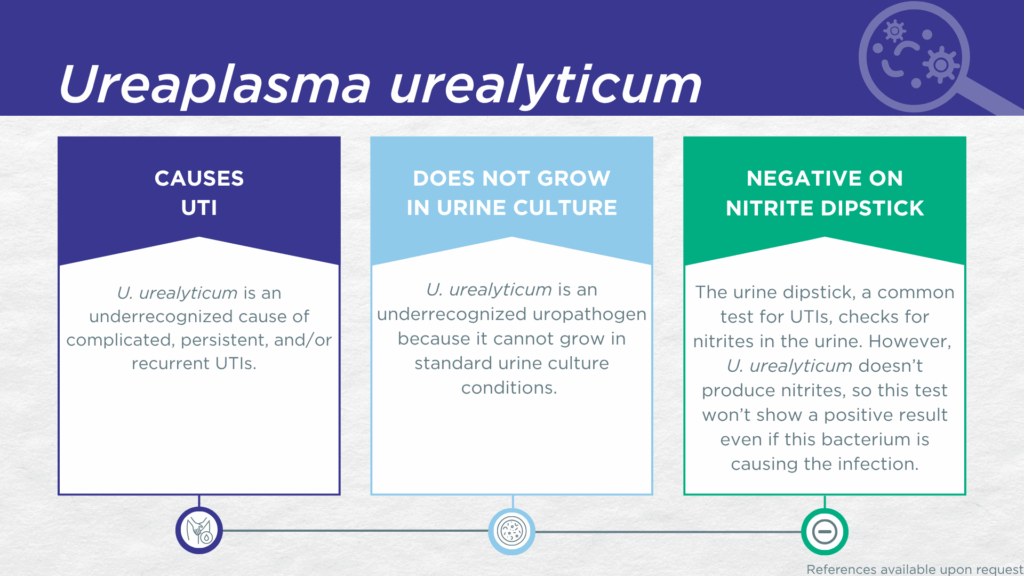
- U. urealyticum is a nitrite-negative, urease-positive, biofilm-forming microorganism lacking a cell wall.
- U. urealyticum is fastidious and cannot grow in standard urine culture conditions.
- U. urealyticum is associated with complicated, persistent, and recurrent UTIs.
- In symptomatic UTI patients, U. urealyticum:
- Is not a contaminant (is found in catheter-collected urine specimens).
- Is pathogenic (associated with elevated urine biomarkers of infection).
Bacterial Characteristics
Gram-stain
Not Applicable (Ureaplasma species do not have a cell wall)
Morphology
Not Applicable (Ureaplasma species do not have a cell wall)
Growth Requirements
Fastidious (slow growing, prefers a pH of 6.0-7.0 & 5% CO2, and requires specific nutrients including urea)
Facultative anaerobe
Nitrate Reduction
No
Urease
Positive
Biofilm Formation
Yes
Pathogenicity
Colonizer or Pathobiont
Clinical Relevance in UTI
This fastidious organism has been considered a colonizer of the urogenital microbiome and is indeed detected in some asymptomatic individuals.[1–3] Clinically, U. urealyticum is most commonly implicated in preterm labor/birth,[4] miscarriage,[5] stillbirth,[6] and intraamniotic infection,[7] as well as bacterial vaginosis (BV) [8]. However, U. urealyticum has also been reported as a causative organism in UTI and pyelonephritis in immunocompromised individuals and kidney transplant recipients.[11–13] It has been detected in men with culture-negative prostatitis [14] or epididymitis,[15] in urinary stones,[16] in the urine of women with unexplained lower urinary tract symptoms improved by azithromycin and/or doxycycline treatment,[17–20] and in the urine of women with UTI symptoms and “sterile” pyuria [3,21]. Even in young otherwise healthy women, U. urealyticum is frequently found in polymicrobial UTIs, where it may persist and contribute to treatment failure despite the fact that a more commonly recognized uropathogen may have been the primary source of the original UTI symptoms.[3,22]
U. urealyticum UTI is an easily missed diagnosis. Firstly, U. urealyticum lacks nitrate reductase activity, so screening strategies involving urinalysis for nitrite positivity will be false-negative.[9,10] Secondly, U. urealyticum is rarely identified in clinical laboratories performing standard culture techniques for UTI diagnosis, because its lack of a cell wall structure prevents the effective use of gram-staining and morphology analyses.[11] Instead, U. urealyticum UTI is most often diagnosed by advanced molecular techniques, including polymerase chain reaction (PCR) and sequencing.[11]
In a study of older adult males and females with clinically suspected complicated UTI, U. urealyticum was detected in both midstream voided and in-and-out-catheter collected specimens indicating that it was truly present in the bladder, not simply a contaminant picked up during voiding.[23] Furthermore, elevated markers of immune system activation in the urinary tract have been measured from the same clinical urine specimens in which U. urealyticum was detected, indicating that the presence of U. urealyticum was associated with an immune response to urinary tract infection.[24–26]
Together, these findings indicate that U. urealyticum should be seriously considered as a uropathogen and demonstrate the value of detecting this organism, particularly in women with chronic or recurrent UTI symptoms and pyuria with a negative standard urine culture.
Note: The primers utilized in the Guidance® assays for U. urealyticum are reported to cross-detect U. parvum due to the genomic similarities between these two recently disambiguated species.[27] Prior to the year 2000, Ureaplasma parvum (U. parvum) was not a recognized species.[28] Instead, it was considered a biovar of the U. urealyticum species (a variant strain that differs physiologically or biochemically from other strains within a particular species). Specifically, what is now U. parvum was called U. urealyticum Biovar 1, but most studies referred to U. urealyticum without specifying biovars. Furthermore, even literature published after 2000 often combines and/or conflates these two species of Ureaplasma, such as by simply reporting “Ureaplasma species”. One study found that U. parvum (previously U. urealyticum biovar 1) was primarily detected in asymptomatic individuals, whereas U. urealyticum (previously U. urealyticum biovar 2) was primarily detected in individuals with symptomatic genitourinary infections and was associated with higher resistance to multiple classes of antibiotics, including macrolides and fluoroquinolones.[29] However, most of the limited number of reports that specifically examine the U. parvum species suggest that U. parvum has similar associations with lower urinary tract symptoms/’sterile’ pyuria as those reported for U. urealyticum.[22,30,31]
Treatment
The lack of a cell wall in U. urealyticum makes the organism inherently resistant to antibiotics whose mechanism of action targets cell wall components. Therefore, U. urealyticum is intrinsically resistant to all beta-lactam antibiotics (including penicillins, cephalosporins, monobactams, and carbapenems) and to vancomycin.
Evidence of Efficacy (Checkmarks): Doxycycline and Levofloxacin.